


We’ll get back to you soon


In coatings, inks, textiles, and plastic formulations, wax additives are widely used to improve surface properties such as scratch resistance, slip, anti-blocking, and water repellency. Two of the most commonly used wax forms are wax dispersions and wax emulsions. Although they may sound similar, their structure, performance, and application methods differ significantly.
If you’re unsure which one to use in your system, this article will help you understand the core differences and guide you in selecting the right wax product.
[caption id="attachment_454" align="aligncenter" width="300"]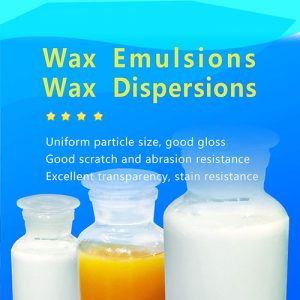 wax dispertions[/caption]
Wax emulsion is a stable mixture of fine wax particles dispersed in water with the help of surfactants. The particle size is usually between 0.1 to 1 micron, and the wax is often chemically emulsified during production.
It appears as a milky liquid and is ideal for water-based systems. Wax emulsions are commonly made from polyethylene (PE), carnauba, paraffin, or amide waxes.
Wax dispersion is a mechanical mixture of wax particles suspended in a liquid carrier, without undergoing an emulsification process. The particle size is usually larger than in emulsions, typically in the 1 to 10 micron range.
The carrier can be water, solvent, or resin, depending on the application. Dispersions are especially popular when higher wax loading or coarse texturing is desired.
1. Production Method
Emulsions are chemically emulsified using surfactants and heat
Dispersions are physically ground or milled using high-shear equipment
2. Particle Size
Emulsion: Very fine (<1 micron)
Dispersion: Coarser (1–10 microns or more)
3. Appearance and Stability
Emulsions are typically stable and translucent or milky
Dispersions may require agitation and may settle over time
4. Application Preference
Use emulsions when working with water-based systems requiring fine surface properties
Use dispersions for solvent-based or resin-rich systems, or when higher texture or wax content is needed
Choose wax emulsion if you need:
A smooth, uniform surface
Low gloss adjustment
Easy integration in water-based coatings or inks
Anti-blocking, water repellency, or slip without affecting transparency
Ideal for:
Water-based wood coatings
Water-based flexo inks
Textile softening or anti-tack finishes
Choose wax dispersion if you need:
Strong scratch or abrasion resistance
Higher wax content (e.g., >10%)
Coarse or matte surface finish
Compatibility with solvent or hybrid systems
Ideal for:
Solvent-based automotive or industrial paints
Leather or plastic coatings with heavy-duty requirements
Powder coating pre-mixes
In most cases, no. While they may contain the same wax type (e.g., PE or PTFE), emulsions and dispersions behave differently in a formula. Replacing one with the other may lead to:
Incompatibility or instability
Sedimentation or phase separation
Unexpected changes in gloss or texture
Always consult your formulation chemist or supplier before switching between forms.
Understanding the difference between wax emulsion and wax dispersion is crucial for formulating stable and high-performance products. Your choice depends on the application system, desired surface properties, and processing method. Selecting the right wax form not only improves end-use performance but also saves cost and avoids reformulation risks.
Not sure which wax form is right for your product? Contact our technical team for expert advice and samples tailored to your formulation needs.
 Leave a message
We’ll get back to you soon