


We’ll get back to you soon


In modern high-speed weaving, textile mills evaluate sizing agents using strictly quantified metrics: kinetic friction coefficient, hairiness values, loom stoppage rates, and reed wear cycles. For acrylic and starch-based textile size manufacturers, formulating with high-performance wax emulsions offers the most direct and cost-effective pathway to drastically improve yarn smoothness and reduce yarn breakage.
This technical guide explores how incorporating wax emulsion into sizing formulations optimizes lubricity, lowers friction coefficients, and delivers higher operational stability for textile mills.
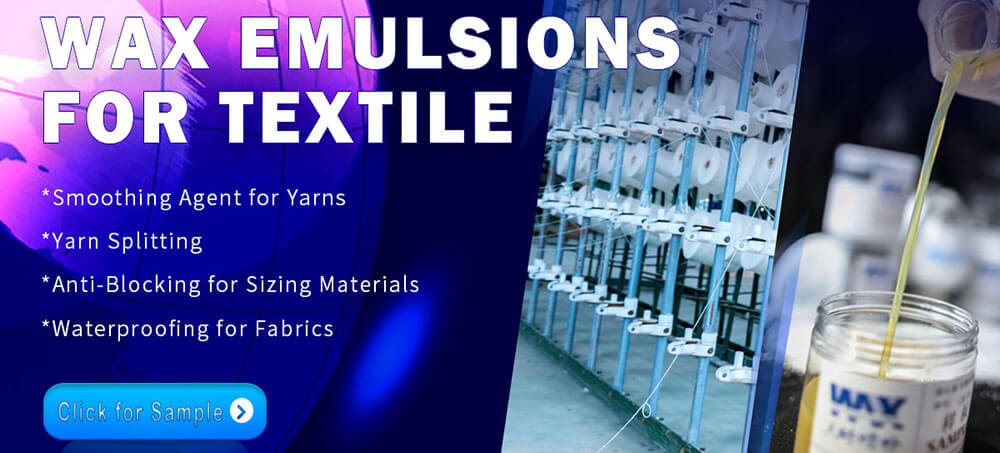
According to textile industry technical data, a single end of warp yarn undergoes 3,000 to 5,000 cycles of intense stretching, flexing, and friction between the droppers, heald wires, and reed during weaving. Any film rupture or raised hairiness caused by friction leads to end-breaks, defects, or machine downtime.
Weaving mills do not simply buy sizing agents—they buy uninterrupted loom efficiency. While acrylic and synthetic sizes excel at fiber adhesion and desizing, they produce relatively rigid films with poor surface lubricity. Adding an emulsion-based lubricant bridges this performance gap.
Weaving mills focus on three key metrics: fewer yarn breaks, cleaner fabric surfaces, and longer reed lifespan. All three directly correlate with the kinetic friction coefficient
| Sizing Condition | Static Friction (μs) | Kinetic Friction (μk) | Key Performance Impact |
| Unwaxed Sized Yarn | 0.30 – 0.35 | 0.25 – 0.30 | High friction, frequent yarn breaks, accelerated reed wear |
| Wax Emulsion Treated Sized Yarn | 0.18 – 0.20 | 0.12 – 0.15 | >50% friction reduction, smoother weaving, minimal hairiness |
Unlike topical oiling, blending wax emulsion into sizing formulations is an integrated four-stage physical process:
Homogeneous Dispersion: Micronized polyethylene wax particles disperse evenly across the aqueous sizing liquor during mixing.
Drying Migration: During drying, water evaporates, initiating film formation by the acrylic polymers. Due to lower surface energy and limited compatibility, wax particles migrate toward the film-air interface.
Surface Enrichment: As drying completes, wax microparticles coalesce at the outermost layer of the size film, creating a continuous, low-surface-energy lubricating barrier.
Boundary Lubrication: During high-speed weaving, contact shifts from a rigid film-to-metal dry friction to a soft wax film-to-metal boundary lubrication, reducing surface drag.
| Feature / Dimension | In-Sizing Blending (Wax Emulsion) | After-Waxing (Wax Rollers) |
| Process & Equipment | Zero machinery modification for mills; added directly into size formulation | Requires dedicated wax roller/spray equipment |
| Uniformity | Uniform distribution across warp sheets | Prone to uneven application across fabric width |
| Dosage Control | Fixed ratio at formulation stage; highly consistent | Risk of wax spots or reduced dyeing affinity if over-applied |
| Fiber Penetration | Microparticles penetrate gaps, enhancing fiber cohesion | Surface-only layer; no internal cohesion enhancement |
Engineered specifically for acrylic sizing formulations, OE-6006 by Nanjing Tianshi New Material Technologies provides an economical and stable lubricity upgrade:
Product Type: Economical Polyethylene (PE) Wax Emulsion
Appearance: Yellowish transparent liquid
Melting Point: $90^\circ\text{C} - 95^\circ\text{C}$
pH Range: $9.5 - 11.5$ (Non-ionic)
Solid Content: $29\% - 31\%$
Recommended Dosage: 3% – 10% (Added during final mixing phase)
Shelf Life: 12 months at room temperature (Keep from freezing)
Q1: What is the optimal addition stage for wax emulsion in textile size manufacturing?
A1: Add the emulsion during the final stage of size mixing under continuous low-to-medium shear agitation. Avoid adding it at high temperatures or under extreme shear to prevent premature emulsion breakdown.
Q2: Will adding PE wax emulsion affect desizing or subsequent dyeing processes?
A2: High-quality non-ionic PE wax emulsions (such as APEO-free formulations like OE-6006) are fully compatible with acrylic desizing systems and leave no hydrophobic residues when washed according to standard textile finishing protocols.
Elevate your sizing agent formulations today. Contact our engineering team at Nanjing Tianshi to request free OE-6006 samples, TDS data sheets, and custom formulation guidance.
 Leave a message
We’ll get back to you soon