


We’ll get back to you soon


However, the term PTFE powder can refer to different material types. High-molecular-weight PTFE resin used for molding and processing is not the same as micronized PTFE wax powder designed for use as an additive.
For manufacturers sourcing PTFE fine powder, understanding this distinction is essential.
Choosing the right supplier also requires evaluating particle size, product composition, dispersion behavior, application compatibility, and quality consistency.
Before purchasing PTFE powder, buyers should confirm which type of material they actually need.
Micronized PTFE Powder
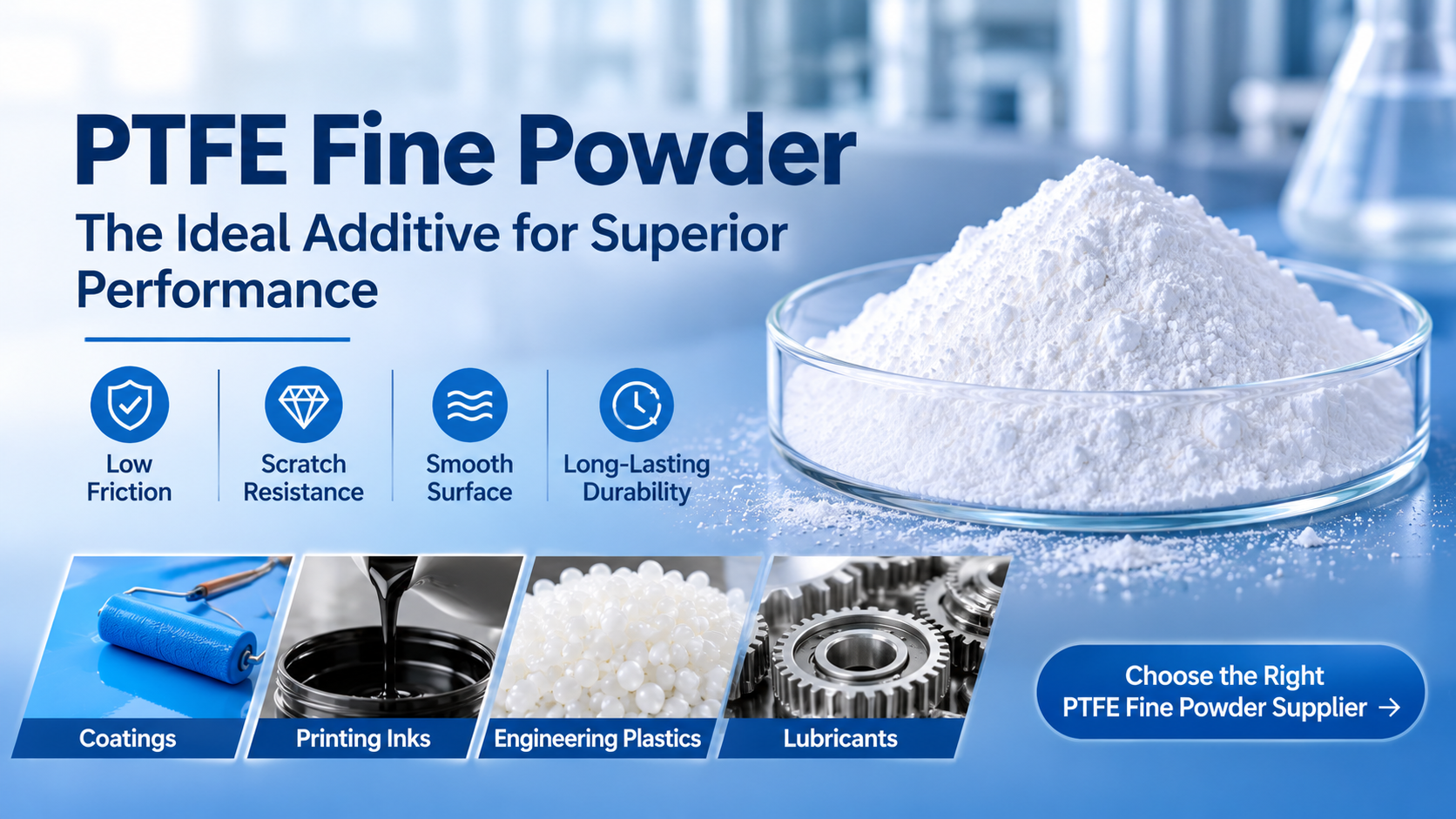
Micronized PTFE powder is a fine-particle material commonly used as a functional additive. It can be incorporated into coatings, printing inks, lubricants, and other formulations to improve selected surface and tribological properties.
Depending on the grade, it can contribute to:
Lower surface friction
Improved scratch and abrasion resistance
Better slip properties
Improved surface smoothness
Enhanced wear performance
PTFE Molding Resin
Conventional PTFE resin is used in manufacturing processes such as compression molding and other specialized processing methods. It is designed to form the final PTFE component rather than simply modify the surface properties of another material.
These materials have different molecular characteristics, processing requirements, and end uses.
If your requirement is a fine powder additive for coatings, inks, or lubricants, you should specifically ask for micronized PTFE wax or micronized PTFE powder rather than general-purpose PTFE molding resin.
Particle size is one of the most important parameters when selecting a PTFE fine powder supplier.
Micronized PTFE grades may have different particle size distributions depending on the intended application.
Two commonly referenced parameters are:
Dv50: The median particle size, indicating that 50% of the measured particle volume is below this value.
Dv90: The particle size below which 90% of the measured particle volume falls.
These parameters help buyers understand the particle size distribution rather than relying on a general description such as fine powder or ultrafine powder.
Why does particle size matter?
In coatings and printing inks, particle size can influence dispersion, surface smoothness, transparency, and the final appearance of the coating film.
In lubricating applications, particle size and dispersion behavior may affect how the PTFE additive is distributed throughout the formulation.
For specialized applications, buyers should compare particle size data and test the product under their actual processing conditions.
Different industrial applications require different performance characteristics.
Coatings
Micronized PTFE is used in selected industrial coatings where low friction, scratch resistance, and surface durability are important.
It can be considered for automotive coatings, industrial coatings, powder coatings, and other specialized surface treatment systems.
The appropriate grade depends on the required surface finish, particle size, compatibility, and dispersion conditions.
Printing Inks
In printing inks, micronized PTFE can function as a slip and abrasion-resistance additive.
It may help reduce surface friction and improve the resistance of printed surfaces to mechanical contact.
For ink manufacturers, dispersion quality and compatibility with the ink binder are important selection factors.
Lubricants and Greases
PTFE micropowder can be used in selected lubricant and grease formulations to modify friction and wear behavior.
The suitability of a particular grade depends on the base oil, thickener system, operating conditions, and required tribological performance.
Engineering Plastics
Certain micronized PTFE grades are also designed for use in engineering plastics.
In these applications, the manufacturer should evaluate the compatibility of the PTFE additive with the polymer matrix and the processing conditions.
Not every micronized PTFE grade is interchangeable across these applications. Selecting a product specifically developed for the intended system is important.
A PTFE fine powder may have suitable particle size specifications but still require careful evaluation during formulation.
Poor dispersion can lead to uneven additive distribution, inconsistent surface properties, or processing difficulties.
Before selecting a supplier, consider:
How easily the powder can be incorporated into your formulation
Whether the product is compatible with your resin or base material
Whether high-speed mixing or specialized dispersion equipment is required
Whether pre-dispersion is appropriate for your production process
Whether the final product maintains the required surface performance
For coatings and inks, laboratory testing should include dispersion quality, surface appearance, slip, and abrasion resistance.
For plastic and lubricant applications, testing should reflect the relevant processing and performance requirements.
A reliable supplier should be able to provide technical guidance based on the specific grade and intended application.
When comparing PTFE fine powder suppliers, buyers should look beyond the initial quotation.
Important evaluation criteria include:
Product Specifications
Request a technical data sheet covering composition, appearance, particle size, and other relevant parameters.
Manufacturing and Quality Control
Understand the manufacturer's production capabilities and quality management procedures. Consistency between batches is important for manufacturers operating continuous production lines.
Product Range
A supplier offering different micronized PTFE grades can provide more flexibility when your requirements involve different coatings, inks, lubricants, or plastics.
Technical Support
Application-specific recommendations can help reduce unnecessary formulation adjustments and testing time.
Sample Evaluation
Always conduct application testing before moving to bulk purchasing. A product that performs well in one formulation may behave differently in another.
TIANSWAX, developed by Nanjing Tianshi New Material Technologies Co., Ltd., offers a range of micronized PTFE wax products for industrial applications.
Its micronized PTFE product portfolio includes:
PTFE-0104: Micronized PTFE wax for applications requiring fine particle size, slip, and surface protection.
PTFE-0107: Micronized PTFE wax.
PTFE-0103: Slip Agent Micronized PTFE Wax.
PTFE-0129B: Micronized PTFE Texture Wax.
PTFE-0143: Micronized PTFE Wax for Engineering Plastics.
For example, the published technical specifications of PTFE-0104 include a Dv50 particle size of 4–5 μm, a Dv90 of 10 μm, and a melting point of 320°C.
These specifications apply to PTFE-0104 and should not be assumed to represent every grade in the product portfolio.
Different products are designed to address different application requirements. Customers should select a suitable grade based on their formulation, processing conditions, and target performance.
TIANSWAX provides micronized wax products for coatings, printing inks, engineering plastics, lubricants, and other industrial applications.
Selecting the right PTFE fine powder supplier requires understanding the difference between micronized PTFE wax and conventional PTFE resin, evaluating particle size distribution, and confirming compatibility with the intended application.
For industrial buyers, product specifications, dispersion performance, quality consistency, and technical support are all important factors in establishing a reliable supply relationship.
Looking for a reliable PTFE fine powder supplier?
Contact TIANSWAX to explore its micronized PTFE wax product range. Share your application, target particle size, and performance requirements with our team to identify a suitable grade for your industrial formulation.
 Leave a message
We’ll get back to you soon