

2026-07-20 Pageview:89
Hand protection has become the largest segment of the occupational health and safety market. However, behind the rapid growth in production, blooming remains a core technical challenge for work glove manufacturers. When rubber additives (such as sulfur, vulcanization accelerators, antioxidants, etc.) migrate to the surface and crystallize, they form white or pale yellow powdery substances, severely affecting the product’s appearance, feel, and performance.
I. Blooming Problem in Work Gloves: Industry Pain Points and Technical Challenges
1.1 Analysis of the Causes of Blooming
Blooming is a common surface defect in rubber products, essentially caused by the supersaturated migration of compounding agents within the rubber matrix. In the production of latex gloves, the following factors exacerbate blooming:
Blooming not only affects the product’s appearance but also leads to the following problems:
Performance degradation: surface hardening, reduced elasticity, and decreased abrasion resistance.
Adhesion problems: gloves stick together, affecting wearability.
Downgrading and scrapping: increased product defect rate, increasing production costs.
Customer complaints: damaged market reputation and negatively impacted brand image.
Currently, commonly used anti-blooming solutions in the industry have significant shortcomings:
These traditional solutions cannot simultaneously meet the comprehensive requirements of anti-blooming, anti-sticking, slip-resistance, and environmental protection, urgently requiring more professional solutions.
Tianshi LW-104 Technical Principle: Chemical Inertness + Physical Barrier Dual-Effect Mechanism
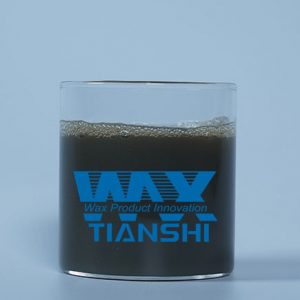
Nanjing Tianshi LW-104 wax emulsion uses advanced non-ionic emulsification technology to disperse special wax materials in an aqueous phase system, forming an aqueous dispersion with uniform particle size and excellent stability. Its anti-blowing and anti-sticking mechanism can be analyzed from two dimensions: chemical and physical.

2.1 Chemical inertness: Blocking the migration of compounding agents
The active ingredients in LW-104 wax emulsion have excellent chemical inertness and do not react chemically with sulfur, vulcanization accelerators, and antioxidants in the rubber system. This characteristic enables it to:
Stand stably exist within the rubber matrix without participating in the vulcanization reaction
Do not affect the crosslinking density and mechanical properties of the original vulcanization system
Maintain good compatibility with various rubber formulation systems (natural rubber, nitrile rubber, PU, PVC)
2.2 Physical Barrier: Prevents “Blooming”
Migration Blocking: During latex vulcanization, the LW-104 wax emulsion softens and migrates to the rubber surface under temperature, forming a continuous, dense microcrystalline wax film.
Crystallization Locking: The wax film has a dropping melting point of 52℃, which is exactly within the latex vulcanization temperature range. It crystallizes and solidifies during vulcanization cooling, “locking” the filler/additive inside the rubber.
Isolation and Protection: The formed wax film layer not only prevents the migration of internal compounding agents but also isolates it from external ozone erosion, delaying ozone aging.
Tianshi LW-104 Core Advantages: Why choose this high-performance product? LW-104 is currently the only wax emulsion product on the market specifically designed to prevent blooming and sticking. Its 52℃ melting point is precisely matched to the latex vulcanization temperature, giving it an irreplaceable advantage in preventing blooming.
Tianshi LW-104 Application System: Covering Mainstream Work Glove Types
1. Natural Rubber
Application Scenarios: Household gloves, medical latex gloves, industrial latex gloves, disposable examination gloves
Core Functions:
Effectively prevents sulfur and accelerators from migrating to the surface, eliminating white blooming
Gives a smooth surface feel and prevents sticking
Improves demolding efficiency and reduces scrap rate
2. Nitrile Rubber Gloves
Application Scenarios: Oil-resistant gloves, electronics industry gloves, food processing gloves
Core Functions:
Prevents plasticizers and antistatic agents from migrating to the surface
Improves demolding performance and reduces glove deformation
Provides a smooth feel and is easy to wear
3.PVC Gloves
Application Scenarios: Food packaging gloves, cleaning gloves, light industrial protective gear
Core Functions:
Prevents plasticizer migration and blooming
Provides a smooth surface, preventing sticking
Improves weather resistance and delays aging
Addition Stage and Method
Nanjing Tianshi LW-104 anti-blowing and anti-sticking wax emulsion, with its unique chemical inertness and precise physical barrier mechanism, provides a one-stop solution for work gloves manufacturers.
Core Value Summary:
Precise anti-blowing: 52℃ melting point design perfectly matches latex vulcanization processes, effectively preventing filler migration.
Superior anti-sticking: The surface wax film provides a smooth isolation layer, making gloves easy to peel off.
Wide compatibility: Non-ionic design, suitable for mainstream systems such as natural rubber, nitrile rubber, PVC, and PU.
High cost-effectiveness: Addition amount is only 1.5%~2.5%, reducing overall cost by 30%~40%.
Green and environmentally friendly: Water-based system, no dust pollution, compliant with REACH/RoHS standards.
 Leave a message

We’ll get back to you soon