

2025-12-03 Pageview:458
Wax emulsion has become an essential auxiliary in modern textile finishing, especially in applications requiring softening, smoothness, reduced friction, and improved fabric handling. As textile manufacturers search for more stable, water-compatible, environmentally friendly additives, wax emulsions—especially polyethylene wax emulsion and synthetic wax emulsions—provide a versatile solution that works well in cotton, polyester, blends, denim, and even technical fabrics. The reason wax emulsion performs effectively in textile softening and lubrication lies in its unique particle size, surface activity, and film-forming capability, which allow it to modify the hand feel and friction coefficient of fibers without causing yellowing, residue, or washability issues. In textile softening, wax emulsion forms a thin, uniform, and flexible film on fibers, creating a smooth surface that improves the fabric’s hand feel and enhances the drape. This softening effect is not greasy and does not negatively impact breathability. Instead, it reduces surface roughness and gives fabrics a subtle softness that feels natural instead of overly “siliconized.” Meanwhile, the lubrication function of wax emulsion is crucial for preventing needle cutting, reducing yarn-to-metal friction, and minimizing abrasion in processes such as weaving, knitting, sewing, and garment washing. A stable lubrication layer allows yarns to move more freely, helping manufacturers improve machine efficiency and lower defect rates.
In denim washing and garment finishing, wax emulsion plays an important role in preventing excessive abrasion while maintaining fabric strength during processes such as stone wash, enzyme wash, and bleach wash. It protects the fiber surface, reduces fuzzing, and prevents damage caused by high mechanical forces. Many dyeing and finishing plants use wax emulsions in the final bath to enhance smoothness, antistatic properties, and resistance to fiber breakage. In sewing, wax emulsion helps reduce broken stitches and heat buildup from high-speed needles. It also prevents thread fluffing and improves stitch uniformity. The improved lubrication is especially valuable for high-density fabrics, coated fabrics, denim, and knitted garments that are prone to friction-related issues. One core advantage of wax emulsion is its excellent compatibility with other textile chemicals such as silicone softeners, cationic softeners, hydrophilic agents, and acrylic binders. When added to finishing formulations, wax emulsion does not destabilize the bath or reduce performance. Instead, it enhances other additives by improving distribution, reducing tackiness, and enabling more uniform deposition on fibers.
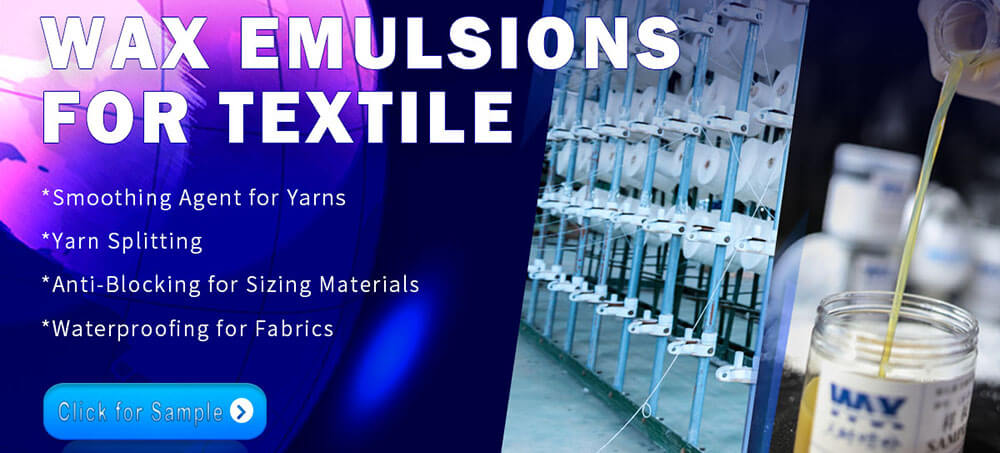
Wax emulsion is also valued for its anti-blocking and anti-adhesion properties in textile finishing. By lowering surface stickiness, it prevents fabrics from sticking to each other during padding, drying, and calendaring, thereby improving process stability. This function is particularly important for fabrics with coatings, printing binders, or heat-sensitive finishes. The durability of wax emulsion is another major reason it is widely used in textile softening. Thanks to its controlled particle size and chemical structure, wax emulsion provides washability resistance while maintaining softness. This is essential for everyday apparel that undergoes repeated laundering. Some specialized wax emulsions also offer water repellency, anti-scratch performance, or heat-resistant lubrication for technical textiles. The ability to tailor performance makes wax emulsion suitable for multiple textile categories including sportswear, casual wear, industrial fabrics, nonwovens, denim, home textiles, and workwear.
From the perspective of sustainability, wax emulsions—especially polyethylene wax emulsions and synthetic emulsions—are more environmentally friendly than traditional solvent-based waxes. Their water-based, low-VOC nature supports green manufacturing trends and regulatory compliance. As textile factories worldwide shift toward more responsible production methods, wax emulsions become increasingly important due to their balance of performance, cost efficiency, and environmental safety. For manufacturers looking to improve production efficiency, reduce friction problems, enhance fabric quality, and lower defect rates, wax emulsion provides a reliable, cost-effective, and non-yellowing solution. It offers a consistent soft touch, stable lubrication, and broad compatibility across different textile systems. Whether used alone or combined with silicone softeners, wax emulsion delivers a powerful enhancement to both fabric feel and process stability.
If you are a textile manufacturer, garment washing plant, or chemical distributor searching for a high-performance wax emulsion that enhances softness, smoothness, lubrication, and durability, TIANSWAX can provide customized solutions based on fiber type, finishing process, and performance requirements. We supply stable, high-solid wax emulsions designed for textile finishing lines worldwide. Contact us for samples, formulation guidance, and technical support to help improve your production results and fabric quality. Send us a message anytime.
 Leave a message

We’ll get back to you soon