

2026-07-09 Pageview:114
With the rapid development of the food and beverage metal packaging industry and the continuous tightening of environmental regulations, water-based can coatings are undergoing a profound transformation from solvent-based to water-based. In 2025, the national output of metal cans reached 43.6 billion units, with the beer can rate increasing to 38.7%, placing higher demands on the coating efficiency and surface slippery feel of can coatings.
I. In the process of water-based systems replacing traditional solvent-based coatings, a prominent production pain point has become increasingly apparent—insufficient external coating slippery feel. A high coefficient of friction on the coating surface leads to poor can conveying, stacking and sticking, and jamming during sorting on high-speed filling lines, directly affecting the efficiency of rapid mass production and even causing a high rate of finished product scrap.
II. Analysis of the Production Pain Point of Insufficient External Coating Slippery Feel
On high-speed can production lines (with line speeds typically reaching 600-2000 cans/minute), the cans need to undergo multiple processes such as coating, drying, conveying, stacking, and sorting. Insufficient slip resistance of the outer coating can trigger a series of chain reactions:
(1) High conveying friction resistance. When the coefficient of friction (COF) of the coating surface is too high, the friction between the can and the conveyor belt and guide rail increases, causing unstable operation and positional deviation, especially under high-speed conditions. Studies have shown that carnauba wax emulsion in coatings can reduce the coefficient of friction of the coating by 30%-50%, directly improving the smoothness of conveying.
(2) Stacking adhesion and thermal adhesion problems. Canned products need to be stacked in multiple layers during warehousing and transportation. If the coating’s anti-stick properties are insufficient, especially in high-temperature environments in summer (coating temperature exceeds 40°C), interlayer adhesion is very likely to occur, leading to coating tearing and batch scrapping when unpacking. Industry data shows that the scrap rate due to stacking adhesion in traditional solutions is as high as 8%-12%.
(3) Line jamming and efficiency loss in the filling line. On high-speed filling lines, insufficient slip resistance of the can leads to poor can feeding by the star wheel and frequent line jamming. Each line stoppage for clearing takes 5-15 minutes, directly affecting the single-line capacity utilization rate. The average coating consumption per can has increased from 8.2g/can in 2021 to 9.6g/can in 2025. This increased coating amount further exacerbates the difficulty in controlling the surface adhesion of the coating.
(4) Surface feel and appearance quality. End-user brands increasingly demand a smoother feel and higher gloss in the appearance of cans and tins. Adding 2%-5% wax emulsion can significantly improve the feel score, balancing functionality and sensory quality.
III. Mechanism of Wax Emulsion Enhancing Coating Slippery Feel
The mechanism of wax emulsion in water-based coating systems can be summarized in three stages:
(1) Migration and film formation stage. Water-based wax emulsions have a particle size distribution below 1μm. During the evaporation of water after coating, wax particles spontaneously migrate and accumulate to the coating surface due to their low surface energy, forming a uniform wax film layer. This “surface enrichment” effect is the core physical mechanism by which wax emulsion provides slippery feel.
(2) Nonionic emulsification stabilization stage. CE-11 employs a nonionic emulsion system (ionic: nonionic nitrogen), with a pH range of 7-9. It exhibits excellent chemical stability in mainstream can coating resin systems such as waterborne acrylic, waterborne polyester, and waterborne epoxy, and will not demulsify or flocculate due to ionic interactions.
(3) Continuous Lubrication Stage. Carnauba wax has a dropping melting point of 82°C, maintaining a solid microcrystalline structure within the normal storage and transportation temperature range of the can, continuously providing a low-friction surface. Simultaneously, the wax layer forms a hydrophobic barrier on the coating surface, preventing the coating from becoming sticky when heated, and giving the coating a lasting leveling and anti-stick effect.
IV. Technical Analysis of CE-11 Carnauba Wax Emulsion
The core functional features of CE-11 include:
Abrasion and scratch resistance: Forms a tough wax film on the coating surface, improving gloss and soft feel;
Enhanced waxy feel and gloss: Gives the coating a delicate waxy touch and visual gloss;
Leveling and anti-sticking: Prevents the coating from becoming sticky when heated, improving storage stability in high-temperature environments;
Convenient application: Can be directly added to the system and stirred before use, without pre-dispersion or special processes;
V. Application Advantages of CE-11 in Water-based Canned Coatings
The application advantages of CE-11 in water-based canned coatings are reflected in the following dimensions:
(1) Significantly reduces the coefficient of friction. (1) Reduces the coefficient of friction (COF) of the coating by 30%-50%, resulting in smoother can transport on high-speed filling lines, reducing the jamming rate of the star wheel feeder by over 60%, and increasing single-line capacity utilization by 15%-20%.
(2) Eliminates stacking adhesion problems. The wax-based anti-stick layer reduces the scrap rate due to stacking adhesion in storage from 8%-12% to below 2%. Based on the industry’s total annual production of 43.6 billion metal cans, this translates to a reduction of millions of can scrap losses annually.
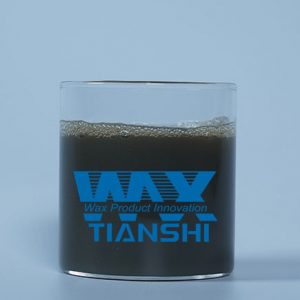
(3) Improves batch consistency. The milky white liquid form and stable emulsion system with 30% solids content ensure precise control of the amount added per batch. Coating uniformity is superior to powder wax additives, and the batch-to-batch color difference ΔE is controlled within 0.5.
(4) Shortens the process cycle. No grinding or dispersion process is required; it can be directly added after stirring. The paint mixing time per batch is reduced by 20-30 minutes, offering significant advantages in high-volume, rapid processing production scenarios.
(5) Compatible with mainstream water-based resin systems. Its nonionic emulsifying properties ensure good compatibility with commonly used resin systems in can coatings, such as waterborne acrylic, waterborne polyurethane, and waterborne epoxy, preventing surface defects like pinholes and fisheyes.
VI. Dosage and Application Guidelines
The standard dosage for CE-11 is 2%-10%.
Nanjing Tianshi New Material Technology Co., Ltd., a professional enterprise with over 20 years of experience in the wax additive industry, has developed into a high-tech enterprise integrating R&D, production, and sales. The group covers a total area of 135 acres, with a total investment of 400 million RMB, an annual production capacity of 50,000 tons, and products covering over 100 varieties of waxes. It holds 93 patents and has a 4,000㎡ R&D and experimental center.
 Leave a message

We’ll get back to you soon